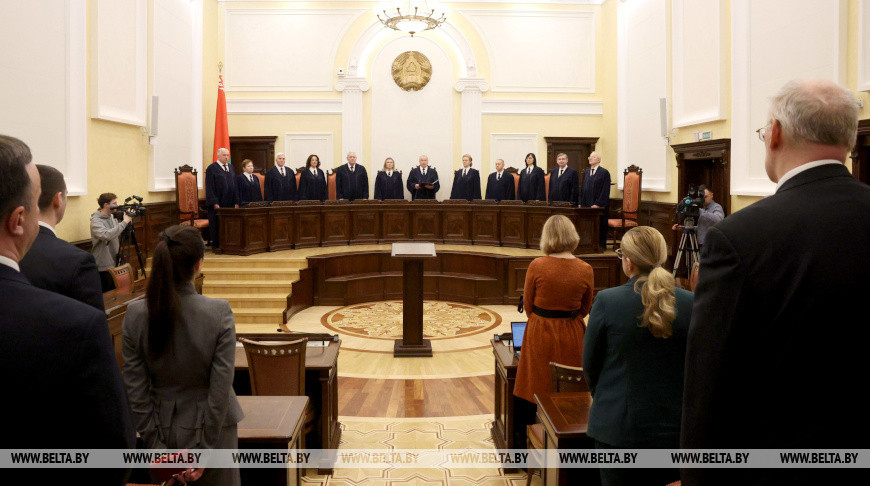
In March 2024, the Constitutional Court of Belarus published its regular message to the President and both chambers of Parliament, titled "On the State of Constitutional Legality in the Republic of Belarus”.
As expected, the document affirmed that "all subjects of constitutional relations are acting within their constitutional powers, rights, and duties, maintaining proper constitutional order in the country". However, it also included some interesting statistics.
"Over the course of 2024, the Constitutional Court received 530 submissions, of which 103 to some extent met the criteria for a constitutional complaint. The complaints raised issues relating to violations of rights in the areas of labour, housing, land, pensions, and taxation law, as well as criminal procedure, administrative, and civil procedure law. Incoming complaints are reviewed in line with the procedure set out in the Law on Constitutional Proceedings, and decisions are made based on the conditions of admissibility and the general requirements for constitutional complaints. An analysis of the complaints shows that citizens often fail to fully meet these requirements, which is why many cases are rejected at the preliminary stage."
Thus, in 2024, the Court accepted for consideration (meaning it found admissible) just 19% of all complaints submitted. You can find an analysis of two of the Court’s conclusions on our website.
The first case involved a fairly common problem: a single person facing multiple penalties based on several administrative offence reports. The complainant in question had three reports filed against him and ended up being fined a total of 245 base units, along with a seven-year ban on engaging in any activity related to driving motor vehicles. He argued that under Article 7.4 of the Code of Administrative Offences (CAO), the reports should have been reviewed together, applying a limit to the total penalty. However, the head of the local Road Traffic Inspectorate, who reviewed the cases, interpreted Article 12.4 of the Procedural-Executive Code on Administrative Offences (PECAP) as giving the authority the option — but not the obligation — to combine cases.
In the end, the Constitutional Court did not rule on whether Article 12.4 PECAP makes consolidation mandatory. It merely noted that the provision leaves it to the discretion of the authority involved. The Court therefore found no grounds to declare Article 12.4 unconstitutional. It did, however, point out that there is a contradiction and inconsistency between Articles 7.4 CAO and 12.4 PECAP — but it stopped short of declaring either provision unconstitutional. Instead, it recommended that the legislature address the legal uncertainty. The Court’s recommendations, though, were very mild and non-specific.
In the second case, the matter concerned tax issues. Between 2010 and 1 January 2022, the Tax Code included a provision (first part of paragraph 19, Article 208) that exempted from personal income tax the income earned from the sale of agricultural, horticultural, and orchard products without any exceptions.
However, as of 1 January 2022, changes were introduced to Article 19 of the Tax Code that effectively eliminated part of this exemption. These amendments shifted the date of income recognition to the formal date of filling out the tax declaration and introduced retroactive taxation for previous periods. As a result, the citizen was assessed additional taxes, which he disputed, challenging the decision through the courts, appeals, and four supervisory reviews before finally reaching the Constitutional Court.
The Court found that the mechanism introduced in 2022 altered the taxpayer’s rights and obligations for a period that had already passed. It went on to conclude that the new rules for conducting desk audits and reassessing taxes — specifically in cases where income exceeded 200 base units during the tax period — disregarded the previously existing tax exemptions and worsened the taxpayer’s legal position, imposing consequences that had not been foreseen under the law in force before 1 January 2022.
The Court’s general conclusion was that the law, which retroactively cancelled an existing exemption and effectively demanded that the exempted sums be repaid to the budget, was unconstitutional insofar as it applied to past periods. The manoeuvre of shifting the date of income recognition to the date of filing the tax declaration was also found to violate broader principles of tax law — although the Court’s discussion of exactly which principles were violated was rather brief. At a minimum, the rule was found to violate the principle of legal certainty.
However, there is a disappointing element in the decision: the Court did not categorically declare that retroactive taxation is impermissible. Instead, it simply stated that the ninth to twelfth parts of paragraph 19, Article 208 of the Tax Code must only apply to future tax periods and cannot be extended to tax periods that had already been completed, during which income from agricultural product sales was exempt from personal income tax.
Our project will continue to monitor the Constitutional Court of Belarus and the decisions it hands down.
Our goal is to provide information that helps defend rights, improve the human rights situation for everyone, and expand the space for freedoms. In the current environment, turning to the relevant bodies — including the Constitutional Court — remains one way of protecting rights. It may not always be effective; institutions may work poorly, incompetently, or with bias. Nevertheless, we believe that legal professionals must approach this work with professionalism. At present, there are no alternative institutions. That is why we see it as crucial to build legal capacity, to teach the principles of the rule of law, and to familiarise the legal community with relevant standards — so that it becomes a significant actor in the defence of human rights.
As expected, the document affirmed that "all subjects of constitutional relations are acting within their constitutional powers, rights, and duties, maintaining proper constitutional order in the country". However, it also included some interesting statistics.
"Over the course of 2024, the Constitutional Court received 530 submissions, of which 103 to some extent met the criteria for a constitutional complaint. The complaints raised issues relating to violations of rights in the areas of labour, housing, land, pensions, and taxation law, as well as criminal procedure, administrative, and civil procedure law. Incoming complaints are reviewed in line with the procedure set out in the Law on Constitutional Proceedings, and decisions are made based on the conditions of admissibility and the general requirements for constitutional complaints. An analysis of the complaints shows that citizens often fail to fully meet these requirements, which is why many cases are rejected at the preliminary stage."
Thus, in 2024, the Court accepted for consideration (meaning it found admissible) just 19% of all complaints submitted. You can find an analysis of two of the Court’s conclusions on our website.
The first case involved a fairly common problem: a single person facing multiple penalties based on several administrative offence reports. The complainant in question had three reports filed against him and ended up being fined a total of 245 base units, along with a seven-year ban on engaging in any activity related to driving motor vehicles. He argued that under Article 7.4 of the Code of Administrative Offences (CAO), the reports should have been reviewed together, applying a limit to the total penalty. However, the head of the local Road Traffic Inspectorate, who reviewed the cases, interpreted Article 12.4 of the Procedural-Executive Code on Administrative Offences (PECAP) as giving the authority the option — but not the obligation — to combine cases.
In the end, the Constitutional Court did not rule on whether Article 12.4 PECAP makes consolidation mandatory. It merely noted that the provision leaves it to the discretion of the authority involved. The Court therefore found no grounds to declare Article 12.4 unconstitutional. It did, however, point out that there is a contradiction and inconsistency between Articles 7.4 CAO and 12.4 PECAP — but it stopped short of declaring either provision unconstitutional. Instead, it recommended that the legislature address the legal uncertainty. The Court’s recommendations, though, were very mild and non-specific.
In the second case, the matter concerned tax issues. Between 2010 and 1 January 2022, the Tax Code included a provision (first part of paragraph 19, Article 208) that exempted from personal income tax the income earned from the sale of agricultural, horticultural, and orchard products without any exceptions.
However, as of 1 January 2022, changes were introduced to Article 19 of the Tax Code that effectively eliminated part of this exemption. These amendments shifted the date of income recognition to the formal date of filling out the tax declaration and introduced retroactive taxation for previous periods. As a result, the citizen was assessed additional taxes, which he disputed, challenging the decision through the courts, appeals, and four supervisory reviews before finally reaching the Constitutional Court.
The Court found that the mechanism introduced in 2022 altered the taxpayer’s rights and obligations for a period that had already passed. It went on to conclude that the new rules for conducting desk audits and reassessing taxes — specifically in cases where income exceeded 200 base units during the tax period — disregarded the previously existing tax exemptions and worsened the taxpayer’s legal position, imposing consequences that had not been foreseen under the law in force before 1 January 2022.
The Court’s general conclusion was that the law, which retroactively cancelled an existing exemption and effectively demanded that the exempted sums be repaid to the budget, was unconstitutional insofar as it applied to past periods. The manoeuvre of shifting the date of income recognition to the date of filing the tax declaration was also found to violate broader principles of tax law — although the Court’s discussion of exactly which principles were violated was rather brief. At a minimum, the rule was found to violate the principle of legal certainty.
However, there is a disappointing element in the decision: the Court did not categorically declare that retroactive taxation is impermissible. Instead, it simply stated that the ninth to twelfth parts of paragraph 19, Article 208 of the Tax Code must only apply to future tax periods and cannot be extended to tax periods that had already been completed, during which income from agricultural product sales was exempt from personal income tax.
Our project will continue to monitor the Constitutional Court of Belarus and the decisions it hands down.
Our goal is to provide information that helps defend rights, improve the human rights situation for everyone, and expand the space for freedoms. In the current environment, turning to the relevant bodies — including the Constitutional Court — remains one way of protecting rights. It may not always be effective; institutions may work poorly, incompetently, or with bias. Nevertheless, we believe that legal professionals must approach this work with professionalism. At present, there are no alternative institutions. That is why we see it as crucial to build legal capacity, to teach the principles of the rule of law, and to familiarise the legal community with relevant standards — so that it becomes a significant actor in the defence of human rights.
